
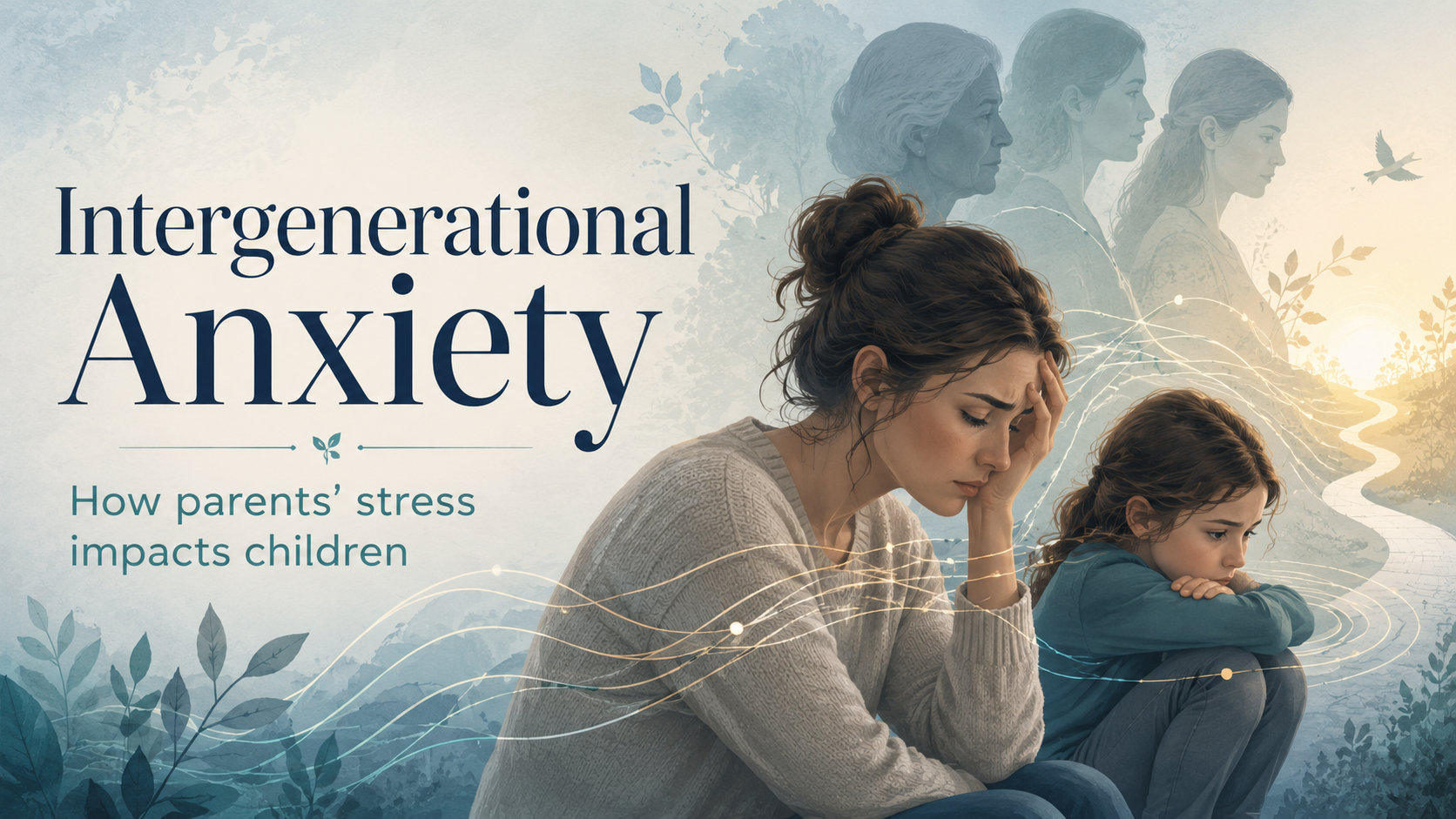
Intergenerational Anxiety: How Parents’ Stress Impacts Children
Amanda never thought of herself as an anxious parent.
She loved her children deeply, worked hard to provide for them, and tried to keep everything together despite constant financial stress, exhaustion, and overwhelming worry. Still, her home often felt tense. Small problems became large ones quickly. Her tone of voice would sharpen when she felt overwhelmed. Some days she would emotionally withdraw because she simply had nothing left to give.
Over time, her eight-year-old son began complaining of stomachaches before school. He became fearful of making mistakes and frequently asked her if everything was “okay”. By the time he was an adolescent, he struggled with perfectionism, social anxiety, and would emotional shutdown. Years later, as an adult, he described feeling as though his nervous system was “always waiting for something bad to happen.”
Stories like this are far more common than many people realize.
Intergenerational anxiety is not simply about genetics or “bad parenting”, it’s the process through which stress, emotional dysregulation, fear, and coping patterns can be passed through families over time. Research has increasingly shown that chronic stress affects not only emotional development, but also nervous system regulation, attachment patterns, and even biological stress responses (Yehuda & Lehrner, 2018).
The good news is that healing is also capable of being passed from one generation to the next.
Parents do not need to be perfect in order to raise emotionally healthy children. Likewise, children who grow up in stressful environments are not permanently damaged. Through self-awareness, emotional connection, therapy, and nervous system regulation, families can interrupt the cycle of anxiety and create healthier emotional patterns for future generations.
How Anxiety Becomes Intergenerational
Children learn about safety, emotions, relationships, and stress primarily through their caregivers. Long before children can logically understand anxiety, their nervous systems are already primed to observe and adapt to the emotional environment they find themselves in.
When parents experience chronic stress, anxiety, burnout, unresolved trauma, or feel emotional overwhelm, their children often subconsciously absorb these patterns through everyday interactions. These may include:
heightened emotional tension in the home,
irritability or emotional withdrawal,
excessive worry or catastrophizing,
inconsistent emotional responses,
emotional suppression,
conflict avoidance,
or hyper-reactivity to stress.
Children are highly sensitive to emotional environments. Even when parents never verbally communicate fear, children often sense emotional dysregulation through tone of voice, facial expression, body language, and household tension.
Over time, the child’s nervous system may adapt to this environment by becoming hypervigilant or emotionally dysregulated.
This adaptation is not weakness. It is survival.
Research involving Adverse Childhood Experiences (ACEs) demonstrates that chronic stress exposure can influence the child’s ability to regulate their emotions, attachment security, and long-term mental health outcomes (Felitti et al., 1998). Studies involving brain imaging have also shown that chronic stress may affect areas of the brain associated with fear processing. These studies have also shown that it affects their emotional regulation and decision-making, which affects the amygdala, hippocampus, and prefrontal cortex (McLaughlin et al., 2019).
Importantly, trauma is not limited to severe abuse or extreme neglect. Emotional unpredictability, chronic criticism, emotional unavailability, persistent stress, or growing up in an environment dominated by anxiety can also shape a child’s emotional development as well as their brain chemistry and structure.
Anxiety Across Developmental Stages
Intergenerational anxiety often changes form as children grow. What begins as nervous system dysregulation in childhood may later emerge differently in adolescence and adulthood.
Childhood: “Something Feels Unsafe”
Young children often lack the language to explain anxiety directly. Instead, anxiety may appear through behavior or physical symptoms.
A child experiencing chronic stress may become:
clingy or fearful,
emotionally reactive,
unusually sensitive to criticism,
withdrawn,
irritable,
or physically symptomatic through headaches or stomachaches.
For example, a child raised in a home with chronic conflict may constantly monitor adult emotions in an attempt to stay emotionally safe. Another child may become “the perfect child” to avoid upsetting an already stressed parents.
These responses are adaptive strategies developed by the nervous system.
Attachment theory helps explain this process. Children develop secure attachment when caregivers are emotionally responsive, predictable, and attuned to their emotional needs. When caregivers are overwhelmed, emotionally inconsistent, or unavailable, children may develop insecure attachment patterns that contribute to anxiety later in life (Bowlby, 1988).
However, attachments are not fixed forever. Healing relationships and emotionally corrective experiences can strengthen attachment security throughout life.
Adolescence: Perfectionism, Withdrawal, and Overstimulation
Adolescence introduces additional pressures that may intensify anxiety. Teenagers today are navigating social media, academic pressure, economic uncertainty, overstimulation, and social isolation in ways previous generations did not experience.
Anxiety during adolescence may present as:
perfectionism,
social withdrawal,
emotional numbness,
avoidance behaviors,
irritability,
panic symptoms,
or excessive self-criticism.
For some teenagers, achievement becomes a way to control their anxiety. For others, withdrawal and emotional shutdown become protective strategies.
Consider another example:
Marcus grew up with parents who constantly worried about finances and worst-case scenarios. Although his parents cared deeply for him, conversations at home were often centered around fear, stress, and survival. By high school, Marcus developed severe performance anxiety and struggled with panic attacks whenever he felt he might fail academically.
In therapy, Marcus eventually realized he had spent years believing his worth depended on avoiding mistakes.
His insight became the beginning of healing journey.
Adulthood: Living in Survival Mode
Many adults struggling with anxiety do not initially recognize how deeply their early emotional environments shaped them.
Intergenerational anxiety in adulthood may appear as:
chronic worry,
emotional suppression,
hyper-independence,
burnout,
people-pleasing,
relationship difficulties,
perfectionism,
or constant nervous system activation.
Some adults become highly functional externally while internally remaining emotionally exhausted. Others struggle to trust relationships, regulate emotions, or experience safety and rest.
Modern stressors can intensify these patterns even further. Economic instability, social media exposure, chronic uncertainty, being overworked, and post-COVID isolation have contributed to increased stress across families and communities. Research has increasingly linked excessive digital stimulation and social comparison with increased anxiety and depressive symptoms among adolescents and young adults (Twenge et al., 2018).
Without intervention, anxious coping strategies may unintentionally continue across generations, but cycles can change.
Common Myths About Anxiety and Parenting
One of the most damaging misconceptions about parenting and anxiety is the belief that parents must be perfect in order for children to develop in healthy ways.
This is simply not true.
Children do not need perfect parents. They need emotionally engaged caregivers who are willing to repair, reconnect, and model healthy emotional responses over time.
Another harmful myth is that children are naturally resilient regardless of circumstances. While children are capable of resilience, however, resilience is strengthened through supportive emotional connections that make them feel safe, creating healthy coping strategies.
Additionally, anxiety is not purely genetic. Biology matters, but environment, attachment, emotional learning, stress exposure, and nervous system regulation also play pivotal role in shaping emotional health. Most importantly, healing is possible at every stage of life.
The brain maintains the ability to change through neuroplasticity, meaning emotional regulation skills, attachment patterns, and coping strategies can improve over time through meaningful intervention and supportive relationships.
Healing the Cycle
Breaking intergenerational anxiety does not happen overnight. Healing is often gradual and requires both self-awareness and consistent emotional practice. However, research strongly supports the effectiveness of therapeutic interventions that improve nervous system regulation, emotional processing, and healthy relationships.
Cognitive Behavioral Therapy (CBT)
CBT helps individuals identify distorted thought patterns and anxiety-producing beliefs. Many individuals raised in chronically stressful environments develop catastrophic thinking or excessive self-criticism without realizing it.
Learning to challenge these patterns can significantly reduce anxiety over time.
Dialectical Behavior Therapy (DBT)
DBT focuses on emotional regulation, distress tolerance, mindfulness, and interpersonal effectiveness. These skills can be especially helpful for individuals whose nervous systems remain chronically reactive or emotionally overwhelmed.
Attachment-Based Therapy
Attachment-focused therapy helps individuals explore how early relational experiences continue influencing emotional functioning and relationships in adulthood. Secure therapeutic relationships themselves can become healing experiences.
Mindfulness and Nervous System Regulation
Mindfulness-based approaches help calm chronic physiological stress activation. Breathing exercises, grounding techniques, meditation, and body awareness practices can reduce autonomic nervous system arousal and improve emotional regulation (Khoury et al., 2015).
Something as simple as slowing your breathing, improving your sleep, reducing overstimulation, or practicing emotional awareness can significantly improve nervous system functioning over time.
Family Systems Approaches
Family systems therapy reminds us that emotional patterns exist within relationships, not in isolation. Improving communication, emotional attunement, boundaries, and conflict repair can positively affect the whole family. Healing often begins when one person becomes aware enough to respond differently.
What Parents Can Do Right Now
Parents do not need to eliminate all stress from their household in order to help their children. Instead, small and consistent changes often create the greatest long-term impact.
Some practical starting points include:
Model emotional regulationChildren learn more from observation than instruction.
Normalize emotions without shameAnxiety should be discussed with compassion rather than criticism.
Practice emotional repairParents should acknowledge mistakes and reconnect after conflict.
Reduce chronic overstimulationSleep, reduced screen exposure, increase movement, improve nutrition, and quiet time all support nervous system regulation.
Seek support when neededTherapy, community support, mindfulness practices, and emotionally healthy relationships can all strengthen resilience.
Healing does not require perfection. It requires awareness, consistency, and connection.
Conclusion
Intergenerational anxiety is not a life sentence.
While stress, trauma, and emotional dysregulation can influence families across generations, healing can also move across generations. Parents who become more emotionally aware, regulated, and connected are not only helping themselves, but they are also actively reshaping the emotional environments their children develop within.
For clinicians, this work represents an opportunity to approach anxiety with both scientific understanding and compassion. For parents, it offers hope that cycles of fear and hypervigilance can be interrupted.
The same nervous system that learned survival can also learn safety.
And sometimes, healing begins with one person deciding the cycle will not end with them.
References
Bowlby, J. (1988). A secure base: Parent-child attachment and healthy human development. Basic Books.
Felitti, V. J., Anda, R. F., Nordenberg, D., Williamson, D. F., Spitz, A. M., Edwards, V., Koss, M. P., & Marks, J. S. (1998). Relationship of childhood abuse and household dysfunction to many of the leading causes of death in adults: The Adverse Childhood Experiences (ACE) Study. American Journal of Preventive Medicine, 14(4), 245–258. https://doi.org/10.1016/S0749-3797(98)00017-8
Khoury, B., Sharma, M., Rush, S. E., & Fournier, C. (2015). Mindfulness-based stress reduction for healthy individuals: A meta-analysis. Journal of Psychosomatic Research, 78(6), 519–528. https://doi.org/10.1016/j.jpsychores.2015.03.009
McLaughlin, K. A., Weissman, D., & Bitrán, D. (2019). Childhood adversity and neural development: A systematic review. Annual Review of Developmental Psychology, 1, 277–312. https://doi.org/10.1146/annurev-devpsych-121318-084950
Twenge, J. M., Joiner, T. E., Rogers, M. L., & Martin, G. N. (2018). Increases in depressive symptoms, suicide-related outcomes, and suicide rates among U.S. adolescents after 2010 and links to increased new media screen time. Clinical Psychological Science, 6(1), 3–17. https://doi.org/10.1177/2167702617723376
Yehuda, R., & Lehrner, A. (2018). Intergenerational transmission of trauma effects: Putative role of epigenetic mechanisms. World Psychiatry, 17(3), 243–257. https://doi.org/10.1002/wps.20568