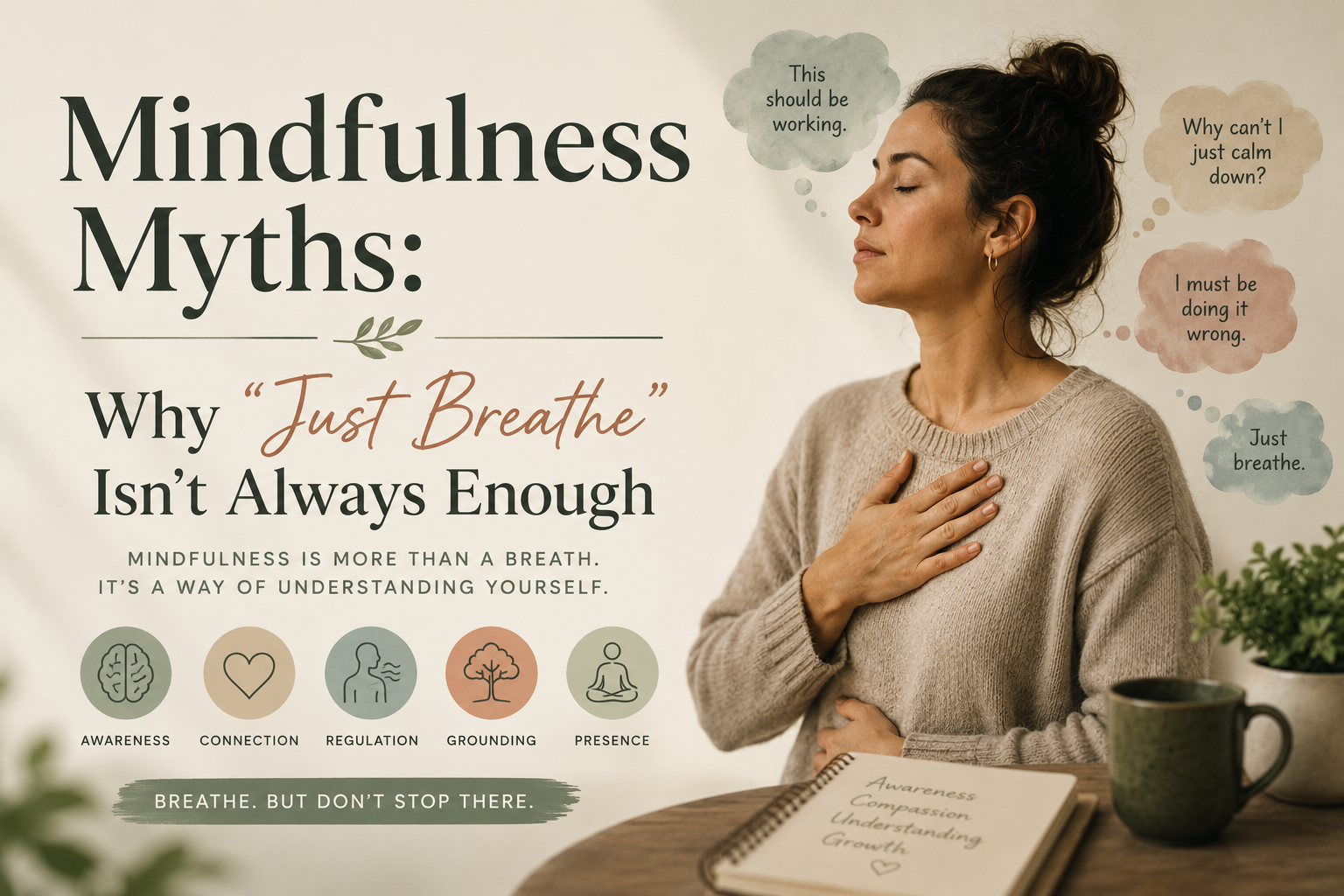
Walk into almost any counseling office, scroll through social media, or listen to modern wellness advice, and eventually you will hear the phrase: “Just breathe.”
The idea itself is not wrong. Breath work can absolutely help regulate the body, slow racing thoughts, and create a sense of grounding during stress. In fact, controlled breathing techniques are used in counseling settings, medical environments, athletic performance training, and even military Special Forces programs because of their ability to influence the nervous system and improve emotional regulation.
However, the growing problem is not that breathing techniques exist — it is that mindfulness has become oversimplified into breathing techniques alone.
As someone working in the counseling field, I have observed many people become discouraged when “just breathing” fails to immediately calm them during moments of trauma, panic, anxiety, grief, emotional triggers, or overwhelming stress. Some people begin to believe mindfulness does not work for them. Others assume they are failing at it entirely.
The truth is far more complex.
Mindfulness is not simply breathing deeply until you feel calm. True mindfulness involves awareness, connection, observation, grounding, emotional processing, physiological regulation, and often deeper reflection regarding meaning, identity, suffering, and purpose. Breath work is one tool within mindfulness — not the entire practice itself.
This distinction matters because people deserve a deeper understanding of how mindfulness actually works and how it can be used effectively in real life.
What Mindfulness Actually Is
Mindfulness is commonly defined within psychology as the intentional act of paying attention to the present moment with openness and without judgment (Kabat-Zinn, 1994). While this definition sounds simple, the actual process is much deeper than many people realize.
Mindfulness involves:
• Observing thoughts without immediately reacting to them
• Becoming aware of emotional states
• Recognizing bodily sensations
• Identifying environmental triggers
• Understanding nervous system responses
• Remaining psychologically present during discomfort
• Connecting mind, body, and spirit
Mindfulness is not passive. It is an active form of awareness.
Rather than escaping discomfort, mindfulness teaches individuals how to remain present within discomfort long enough to understand it. This creates the possibility for intentional responses instead of automatic reactions.
For some people, mindfulness may initially increase discomfort before it creates calm because slowing down allows previously ignored emotions, fears, memories, or physical sensations to become noticeable. This is especially important for individuals with trauma histories, anxiety disorders, panic symptoms, or chronic stress responses.
This is one reason why “just breathe” may not always be enough.
The Physiology Behind Breath Work
Although mindfulness is broader than breathing, breathing exercises remain powerful because they directly influence the autonomic nervous system.
The autonomic nervous system consists primarily of two major branches:
• The sympathetic nervous system
• The parasympathetic nervous system
The sympathetic nervous system is responsible for the body’s “fight-or-flight” response. During perceived danger or stress, this system increases heart rate, muscle tension, breathing speed, cortisol release, and physiological arousal.
The parasympathetic nervous system functions as the body’s “rest-and-digest” system. It helps slow the heart rate, regulate breathing, reduce muscle tension, and return the body toward equilibrium after stress.
One of the most important pathways involved in this regulation is the vagus nerve.
The vagus nerve plays a major role in regulating heart rate, digestion, emotional regulation, and physiological calming responses. Research has shown that slow diaphragmatic breathing can stimulate vagal activity, which may help increase parasympathetic activation and reduce stress-related physiological arousal (Jerath et al., 2015).
In simpler terms, controlled breathing can help tell the body: “You are safe enough to slow down.”
Why Special Forces Use Breath Work
One of the most fascinating examples of breath work comes from military Special Forces and tactical training programs.
High-performance military personnel are trained to regulate physiological arousal under extreme stress because panic, hyperventilation, and emotional flooding impair judgment and reaction time. Controlled breathing techniques are often taught to help stabilize attention, improve focus, maintain situational awareness, and reduce stress reactivity during high-pressure situations.
The military does not use breath work because it is “soft” or trendy. They use it because physiological regulation directly affects performance, cognition, and survival under stress.
This highlights an important point: Breath work is not merely emotional comfort. It is nervous system regulation.
Three Breath Work Techniques
1. Box Breathing
The technique follows a four-part rhythm:
1. Inhale for four seconds
2. Hold for four seconds
3. Exhale for four seconds
4. Hold for four seconds
2. Diaphragmatic Breathing
A simple diaphragmatic breathing exercise includes:
1. Place one hand on the chest and one on the abdomen
2. Slowly inhale through the nose
3. Allow the abdomen to rise while keeping the chest relatively still
4. Slowly exhale through the mouth
5. Repeat gradually
3. 4-7-8 Breathing
The process includes:
1. Inhale for four seconds
2. Hold for seven seconds
3. Exhale slowly for eight seconds
When Breath Work May Not Be Enough
Although breath work can be extremely beneficial, there are situations where focusing solely on breathing may be ineffective or even distressing.
For individuals with:
• Trauma histories
• Panic disorder
• Dissociation
• Severe anxiety
• Respiratory conditions
• Sensory sensitivity
focusing inward on breathing can sometimes intensify discomfort.
Mindfulness, Meaning, and the Human Experience
Mindfulness also extends beyond symptom reduction.
At deeper levels, mindfulness invites individuals to reflect on:
• Meaning
• Purpose
• Identity
• Suffering
• Connection
• Spirituality
• Values
A Step-by-Step Mindfulness Practice
Step 1: Pause
Stop for a moment and acknowledge what you are experiencing without judgment.
Step 2: Regulate the Breath
Use a breathing technique such as box breathing or diaphragmatic breathing for 1–2 minutes.
Step 3: Ground Through the Senses
Notice:
• 5 things you can see
• 4 things you can feel
• 3 things you can hear
• 2 things you can smell
• 1 thing you can taste
Step 4: Observe Thoughts and Body Sensations
Ask yourself:
• What thoughts are repeating?
• Where do I feel tension physically?
• What emotion am I experiencing?
• What triggered this response?
Step 5: Reflect on Meaning and Needs
Consider:
• What do I need right now?
• What would help me feel supported?
• What values do I want to act from in this moment?
Step 6: Respond Intentionally
Choose a grounded response instead of an automatic reaction.
Final Thoughts
Mindfulness is not a quick fix, and it is not simply “just breathing.”
Breath work can absolutely help regulate the nervous system and support emotional awareness, but mindfulness becomes far more powerful when individuals learn to connect breath with grounding, observation, reflection, meaning, and intentional action.
Authored by William Patrickus, Supervised Therapist
References
Brown, K. W., & Ryan, R. M. (2003). The benefits of being present: Mindfulness and its role in psychological well-being. Journal of Personality and Social Psychology, 84(4), 822–848.
Jerath, R., Crawford, M. W., Barnes, V. A., & Harden, K. (2015). Self-regulation of breathing as a primary treatment for anxiety. Applied Psychophysiology and Biofeedback, 40(2), 107–115.
Kabat-Zinn, J. (1994). Wherever you go, there you are: Mindfulness meditation in everyday life. Hyperion.
Ma, X., Yue, Z. Q., Gong, Z. Q., Zhang, H., Duan, N. Y., Shi, Y. T., Wei, G. X., & Li, Y. F. (2017). The effect of diaphragmatic breathing on attention, negative affect and stress in healthy adults. Frontiers in Psychology, 8, 874.
Porges, S. W. (2011). The polyvagal theory: Neurophysiological foundations of emotions, attachment, communication, and self-regulation. W. W. Norton & Company.
van der Kolk, B. A. (2014). The Body Keeps the Score: Brain, mind, and body in the healing of trauma. Viking.
Zaccaro, A., Piarulli, A., Laurino, M., Garbella, E., Menicucci, D., Neri, B., & Gemignani, A. (2018). How breath-control can change your life: A systematic review on psycho- physiological correlates of slow breathing. Frontiers in Human Neuroscience, 12, 353.